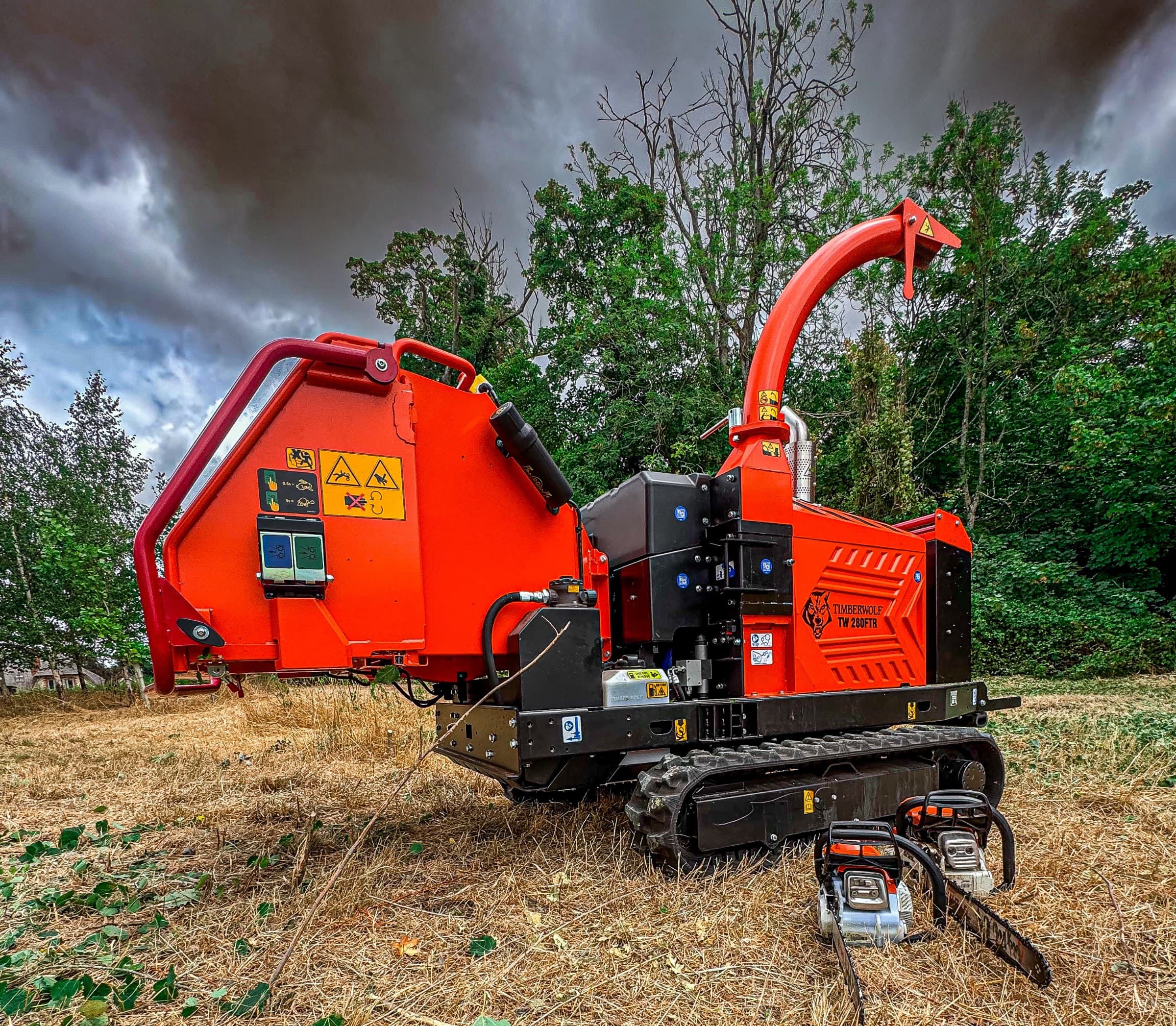
Felling a tree is only half the job. What is left behind is a stump in the way of the mower and a pile of timber too big for an axe. Both have traditionally meant more ringing round: a stump grinding firm for one, and either a weekend of hard work or a trip to the log merchant for the other.
Both are now services in their own right on Emmerdale Agriculture. This article explains what each job involves, what it costs in practice, what to tell contractors so the prices are accurate, and how to get several quotes from one description.
Stump grinding: what actually happens
A stump grinder is a small tracked or wheeled machine with a spinning wheel of carbide teeth. The operator swings the wheel across the stump in passes, chewing it into chips, until the stump is below ground level. The usual finish is 15 to 30cm below the surface, which is enough to mow over, seed, turf or run a fence line through. If you plan to build on the spot or plant another tree there, say so, because the contractor can go deeper and take out the root flare as well.
The big roots are not dug out. They stay in the ground and rot over a few years, which is why grinding leaves the surrounding ground intact where digging a stump out with an excavator leaves a crater and a heap of spoil.
What you are left with is a hole full of grindings: a mix of wood chip and soil. There are two ways to deal with it:
- Leave the grindings in. Cheapest. They settle over a year or so and the hollow needs topping up with soil before grass will grow evenly.
- Take them away and backfill with topsoil. Costs more, but the spot can be seeded the same week.
Either is fine. Just decide before the contractor arrives, because the price is different.
When stump grinding is the right job
Grinding suits almost any stump that is simply in the way: the remains of a felled tree on a field edge, an old orchard row, leylandii taken out of a boundary, or the stumps left after land clearance or tree felling. It is quicker and cheaper than digging out, and a pedestrian grinder will fit through a garden gate.
Dig out with an excavator instead when the ground is being excavated anyway, for foundations, a drive or a pond. And for dozens of small stumps and self-set saplings across an area of scrub, a fixed tooth mulcher grinds the lot where it stands, stumps included, and is usually the better price.
It can be done at any time of year. A grinder on tracks copes with wet ground better than a tractor, though very soft pasture is still worth avoiding if the machine has to cross it. There is no rush: a stump cut flush and left is doing no harm unless it is in the way or starting to throw up suckers.
What stump grinding costs
Stump grinding is priced per stump, and the price per stump depends mostly on size. A 20cm sapling stump is a few minutes of work. A metre-wide oak is most of a morning. For a single stump, expect to pay for the visit as much as the stump, in the same way that small paddocks are priced by the visit rather than the acre. Several stumps on one site are far cheaper each than one on its own.
The other things that move the price:
- Species. Oak, beech and elm are slow. Conifers, willow and poplar are quick.
- Access. Whether a vehicle can drive right up, or a smaller machine has to go through a gate or a narrow gap.
- Depth, and whether the roots around the base are to be ground too.
- Grindings left in or taken away.
- Stones, concrete and old wire around the base, which blunt the teeth and slow the work.
Mobile log splitting: what actually happens
A hydraulic log splitter pushes a ring of timber against a steel wedge and splits it in two or four. Mobile splitting means the contractor brings the splitter to your timber, run off a tractor or its own engine, and works through the stack where it sits. The wood never has to leave your land, and there is no trailer to load, drive and unload.
The splitter needs timber already cut into rings. If yours is still in trunk or branch lengths, there are two options: the contractor rings it up with a chainsaw on the day, which is priced in, or they bring a firewood processor, which saws and splits in one pass and makes sense for a big stack.
Agree the log length before the day. Around 25cm, or 10 inches, suits most stoves; bigger open fires and boilers take longer logs. The split logs then come off into a heap, a trailer, builder's bags, or a stack where you say. Stacking by hand is slow, so it costs extra, but a stack dries faster and more evenly than a heap, and it is the job most people are glad they paid for.
When to split, and how long before you can burn it
Split early. Wood seasons far faster once it is split, because the inside of a ring is sealed by bark and dries slowly. Logs split in late winter or spring have a full summer in a stack to dry.
How long they need depends on the wood. Hardwoods such as ash, beech and oak generally want a year or more in a dry, airy stack, and oak often two. Softwood and thinly split logs can be ready in six months to a year. The test is a moisture meter, which costs a few pounds: below 20% moisture a log burns clean and hot. Wet wood smoulders, tars the flue and wastes most of its heat drying itself out.
Stack logs off the ground, loosely, covered on top but open at the sides. A tarpaulin wrapped right round a stack keeps the wet in.
Two more things worth knowing:
- If you sell logs rather than burn them, the Ready to Burn rules apply in England: wood sold in volumes under 2 cubic metres must be certified as under 20% moisture. Wood for your own fire is not affected.
- Elm, knotty and forked rings often will not split at all by hand. A hydraulic splitter gets through them, but they are slower, so mention them.
What log splitting costs
Log splitting is priced on the pile. The things contractors need to know are:
- How much timber there is. A trailer load, a few loads, or a season's worth from a felling job. A mature ash or beech can give several cubic metres of logs; a hedgerow tree much less.
- What state it is in. Already in rings, in lengths that need sawing, or a mix.
- Species and shape. Straight ash and softwood are quick; elm, big rings and forked timber are slow.
- Access. Whether a tractor or a towed splitter can get right up to the pile, close to it, or whether the timber has to be carried.
- Stacked, bagged or heaped.
Have the pile sorted before the day. Pick out rotten, painted or nail-studded timber, and clear a space beside the pile for the machine and the logs. Time spent moving things around is time you are paying for.
Get prices from one description
Start at the job form, pick stump grinding or mobile log splitting, and give your postcode. The form asks the handful of questions above: how many stumps and how wide the biggest is, how a machine gets to them, and what to do with the grindings; or how much timber there is, what state it is in, whether a tractor can reach it, and whether you want the logs stacked. Add a couple of photos. One of the stump or the pile, and one showing what is around it, answers most of what a contractor would otherwise have to ask.
Your job goes to the approved contractors who cover your postcode: tree surgeons, forestry contractors and agricultural contractors with the kit. Each one prices it on their own without seeing the others' figures. Prices usually start arriving within 24 hours, you get an email as each one comes in, and they all sit together on one page for your job. When you accept one, you pay a 15% deposit by card to book, and the balance goes to the contractor when the work is done.
If you have a tree still standing, it is often cheapest to have the felling, the stump and the logs priced as one visit. Describe the whole job under tree felling and chipping and say you want the stump ground and the timber split, and the contractors will price all three.
Mistakes worth avoiding
- Not checking what is underground. Water pipes, electricity cables, land drains and septic runs can all sit near a tree. Tell the contractor about anything you know of before the grinder starts.
- Planting a new tree straight into the grindings. Fresh wood chip takes nitrogen out of the soil as it rots, and grass or a sapling sown into it will sit yellow for a year. Backfill with topsoil, or plant a metre to one side.
- Expecting grinding to stop regrowth. Willow, poplar, elm and cherry sucker from the roots left in the ground. Mowing or pulling the suckers for a season or two usually exhausts them.
- Leaving logs in rings until autumn. They will not be dry by the time you want them. Split them when the tree comes down, or as soon after as you can.
- Burning wet wood. It is not just inefficient; it coats the chimney in tar and is the usual cause of chimney fires. If you do not have a moisture meter, buy one.