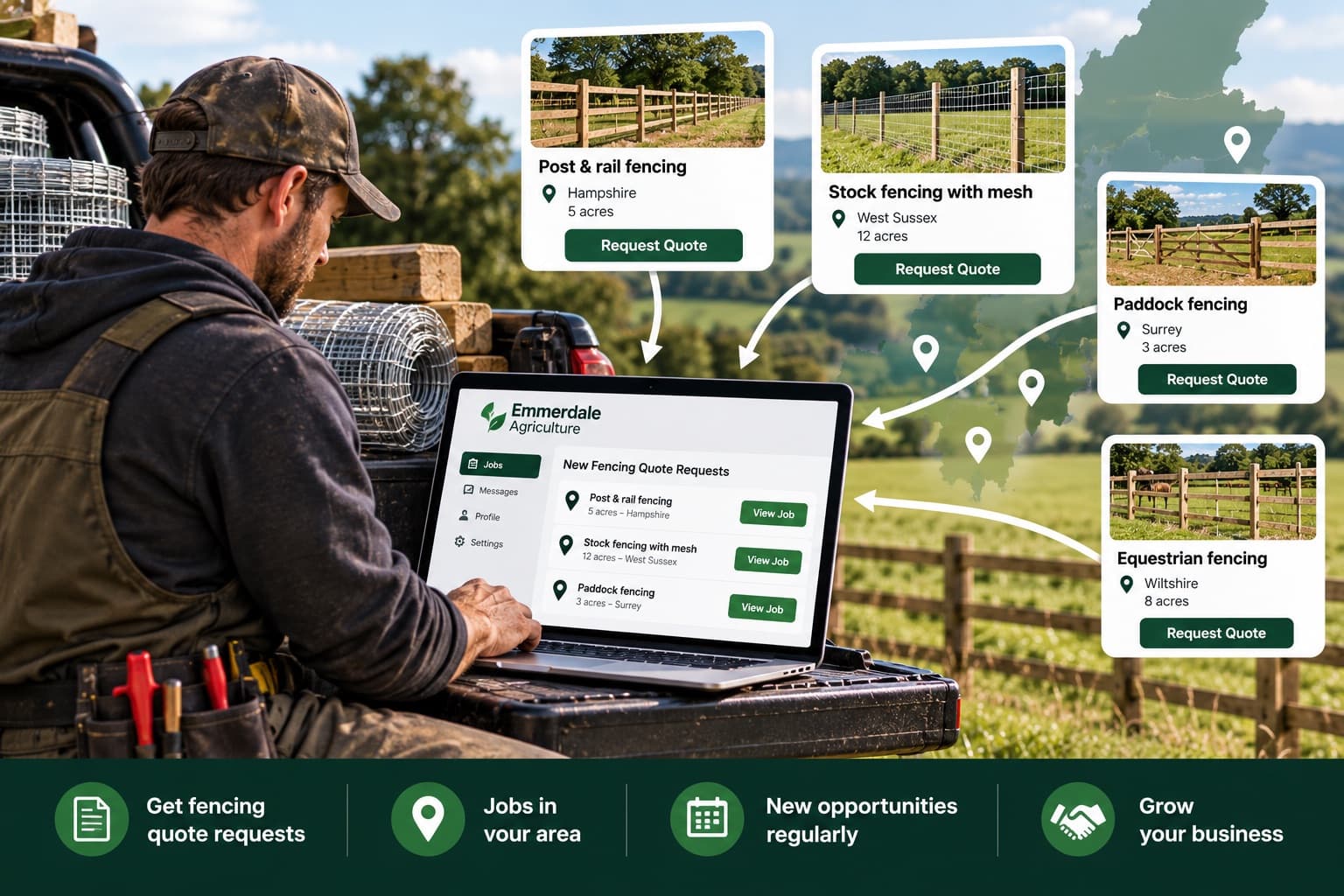
Getting a fence put up usually starts with a lot of phone calls. You find a few fencers, wait for each one to come and measure, and wait again for a price. Some don't turn up. When the prices arrive they are often for slightly different fences, so it's hard to tell which is the better deal.
This article explains how to use Emmerdale Agriculture to get several fencing quotes from one description. It also covers what to tell fencers so the prices are accurate, how to compare them, and what to check before the first post goes in.
What fencing can you get quotes for?
Fencing contractors in our network price all sorts of fencing for homes, paddocks and smallholdings, including:
- Post and rail round a paddock or along a field boundary
- Closeboard (featheredge), built on site or as panels, for a solid boundary
- Lap panels and trellis round a garden
- Picket fencing at the front of a property
- Gates, from a pedestrian gate to a driveway gate or a 12ft field gate
- Replacing an old fence, including taking down and removing what's there
If you need something else, such as stock fencing for sheep or a repair after a storm, describe it in your own words. It still reaches fencers in your area.
Describe the fence once
Start at the job form and pick fencing. Give your postcode and we'll ask you the questions a fencer would ask on the phone. It takes a couple of minutes and there's nothing to pay to ask.
- What type of fencing. There are pictures of each type, so you don't need to know the trade names.
- How tall, from 3ft to 6ft.
- How many metres. Pace it out or measure it roughly. It doesn't need to be exact, but it is the number the price is built on.
- Wooden or concrete posts. Concrete posts last longer and cost more. Wooden posts are more usual for post and rail.
- A capping rail, if it's a boarded fence. It's the strip along the top that protects the board ends from rain.
- Gates, and what size.
- Whether it's on a slope. Sloping ground takes longer to fence.
- Whether the line needs clearing first, such as brambles, hedge or scrub along it.
- Whether there's an old fence to remove.
Add photos if you can, with one along the line of the fence and one of the access. It saves fencers guessing, and it often saves them a trip out to look.
Fencers who cover your area price it
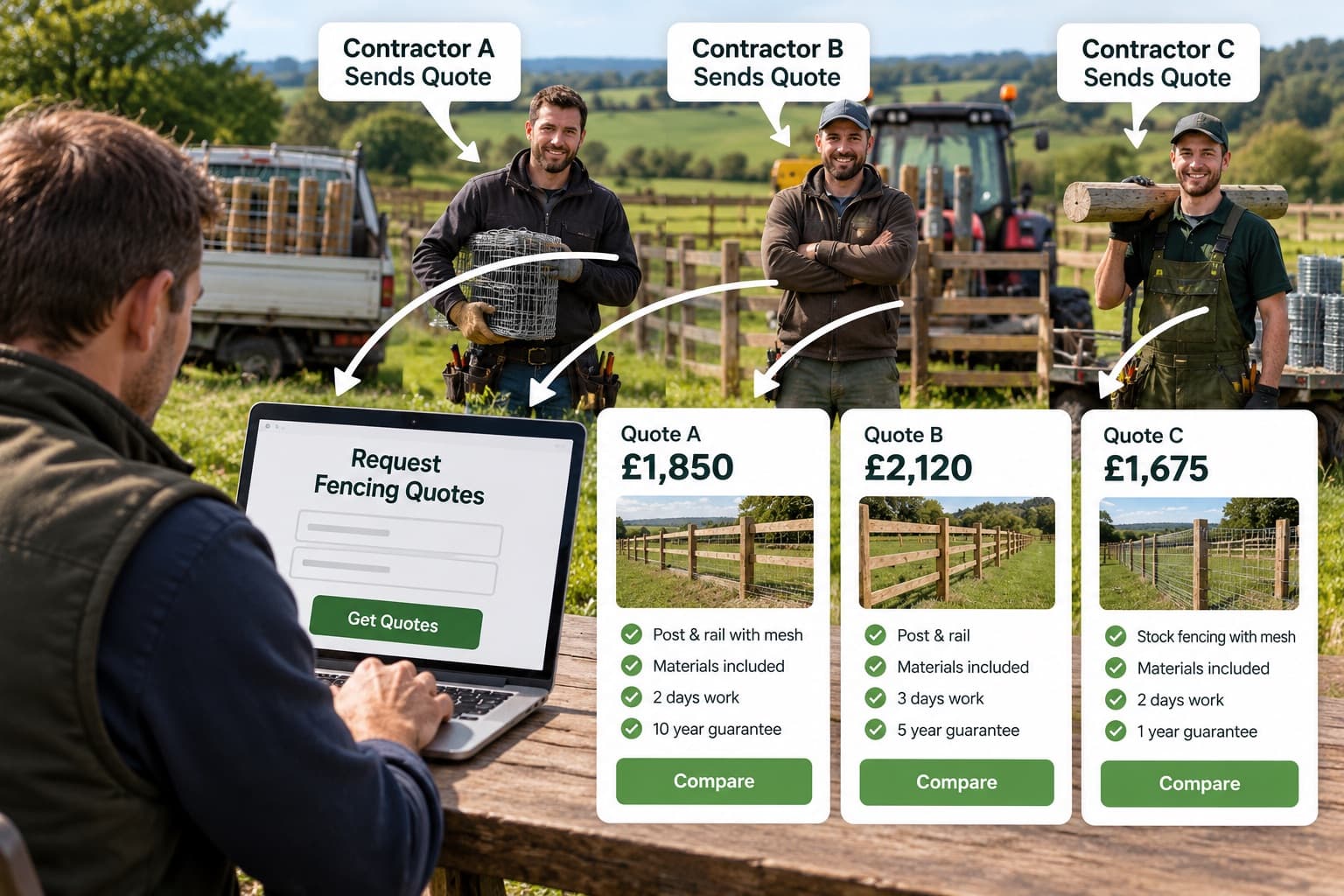
Your job goes to the approved contractors who cover your postcode. Each one prices it on their own, and none of them can see what the others have quoted. So every price is that fencer's honest figure for the job, not a figure set to just beat someone else.
Prices usually start arriving within 24 hours. You get an email as each one comes in, and they all appear together on one page for your job.
Some fencers will want to see the site before they commit to a final figure, especially on long runs, slopes or awkward ground. That's normal. You can book them subject to a visit, and if the price changes after they've seen it, you can accept the new figure or decline it.
Compare like with like
Two fencing prices can be hundreds of pounds apart because they are for two different fences. Before you compare the totals, check what each one includes:
- Posts. Wooden or concrete, and how far apart.
- Materials. Ask whether the timber is pressure-treated, and what size the posts and rails are.
- Gravel boards. On a closeboard or panel fence, a board along the bottom keeps the timber off the soil. Check whether it's included.
- The old fence. Check whether taking it down and taking it away are included, or whether it will be left on site.
- Clearing the line, if it needs it.
- Gates, including hinges and latches.
- VAT. Each price shows the full amount you'd pay, with our fee already included, and says whether VAT is included.
Then look at the rest. Each price comes with the fencer's rating from previous customers, how far away they are, and a note to you. The note often explains what they'd use and when they could start, and it is often where the real difference between two prices shows up.
If anything is unclear, message the fencer from your job page before you decide. You don't need to give out your phone number to ask a question. For more on comparing prices, see how to compare the market for paddock work.
Fencing for horses
If the fence is for a paddock, say so in your description. A few things matter more with horses:
- Post and rail is the usual choice. It's easy for horses to see and has no wire for them to catch a leg in.
- Most horse owners avoid barbed wire, which can cause serious injuries.
- Electric fencing run along the inside of a rail fence stops horses leaning on it and chewing the rails, and makes the fence last longer.
- Height. Fences for horses are usually around 4ft to 4ft 6in, with taller fences for stallions or horses that jump out.
Check before the fence goes up
A few things are worth sorting out before you book:
- Know where your boundary is. Your title deeds or the Land Registry plan may show who owns which boundary. If the fence is on a shared boundary, talk to your neighbour first. Most fencing disputes start with a fence going up a few inches in the wrong place.
- Height limits. In England, you can usually put up a fence up to 2 metres high without planning permission, or up to 1 metre next to a road used by vehicles. Listed buildings, conservation areas and some new-build estates have extra rules, so check with your council if you're unsure. Wales and Scotland have similar rules.
- Underground cables and pipes. Fence posts go deep. If you know of any services along the line, mention them in your description.
Book the one you want
When you accept a price, you pay a 15% deposit by card to book the job. That's all that is taken up front.
The fencer gets in touch to agree a date. When the work is finished, they mark the job complete and you get an email. You then have three working days to confirm you're happy or tell us about a problem. The balance is only taken once you confirm, or once those three days pass without you raising anything.
Why book through the site?
- We check every contractor before they see a job. We confirm who they are and that they run a working contracting business, and we talk to them before any job reaches them.
- Every job is covered by our insurance. We carry £5 million of public liability cover on every job done through the service. If something goes wrong, you deal with us.
- You pay us, not the fencer. If the work isn't right, you raise it with us and we sort it out with the contractor.
Quick answers
How do I get fencing quotes? Describe the fence once, with its type, height and length, and fencers who cover your area send their prices. You compare them on one page and book the one you want.
Is there a charge for getting quotes? No. Posting a job is free, and there's no obligation to accept any of the prices you get.
Will a fencer need to visit before quoting? Not always. With the type, height, length and a few photos, many fencers can price from the description. Some will want to see the site first, especially on slopes or awkward ground.
Which fence is best for a horse paddock? Post and rail is the most common choice, often with an electric strand on the inside to stop horses leaning on it. Most horse owners avoid barbed wire.
Do I need planning permission for a fence? In England, usually not for a fence up to 2 metres high, or up to 1 metre next to a road. Listed buildings and conservation areas have extra rules, so check with your council if you're unsure.
When you're ready, describe your fence here and see what comes back. You can also read more about the fencing work we cover on our fencing contractors page.