Most people compare the market for car insurance without a second thought. For paddock work, hardly anyone does.
Topping, harrowing, weed spraying, fencing or a day of tractor hire usually gets booked the old way. You ask in a Facebook group, ring the one name a neighbour gave you, and take whatever price they say. If you want a second opinion, you start the whole thing again with someone else, and hope they call back.
The prices for the same job can be far apart. In September, the prices customers on this site were shown for topping a one-to-two-acre paddock ranged from £120 to £770 for a single visit. (The paddock topping cost article has the full breakdown.) If you only ever ask one contractor, you have no idea where in that range you landed.
This article explains how to get several prices for a land job from one description, and how to compare them properly once they arrive.
Describe the job once
Start at the job form. Pick the work you need, give your postcode, and say a little about the ground: roughly how big it is, what state it is in, how you get a tractor in, and anything in the way. Photos help. It takes about a minute.
There is nothing to pay to ask, and asking does not commit you to anything.
Every contractor who covers your area sees it
Your job goes to every approved contractor whose patch includes your postcode and who is close enough to reach you. Each one prices it on their own. None of them can see what the others have quoted, so nobody is pricing to beat the cheapest bid they've heard about. Each price is simply what that contractor thinks the job is worth.
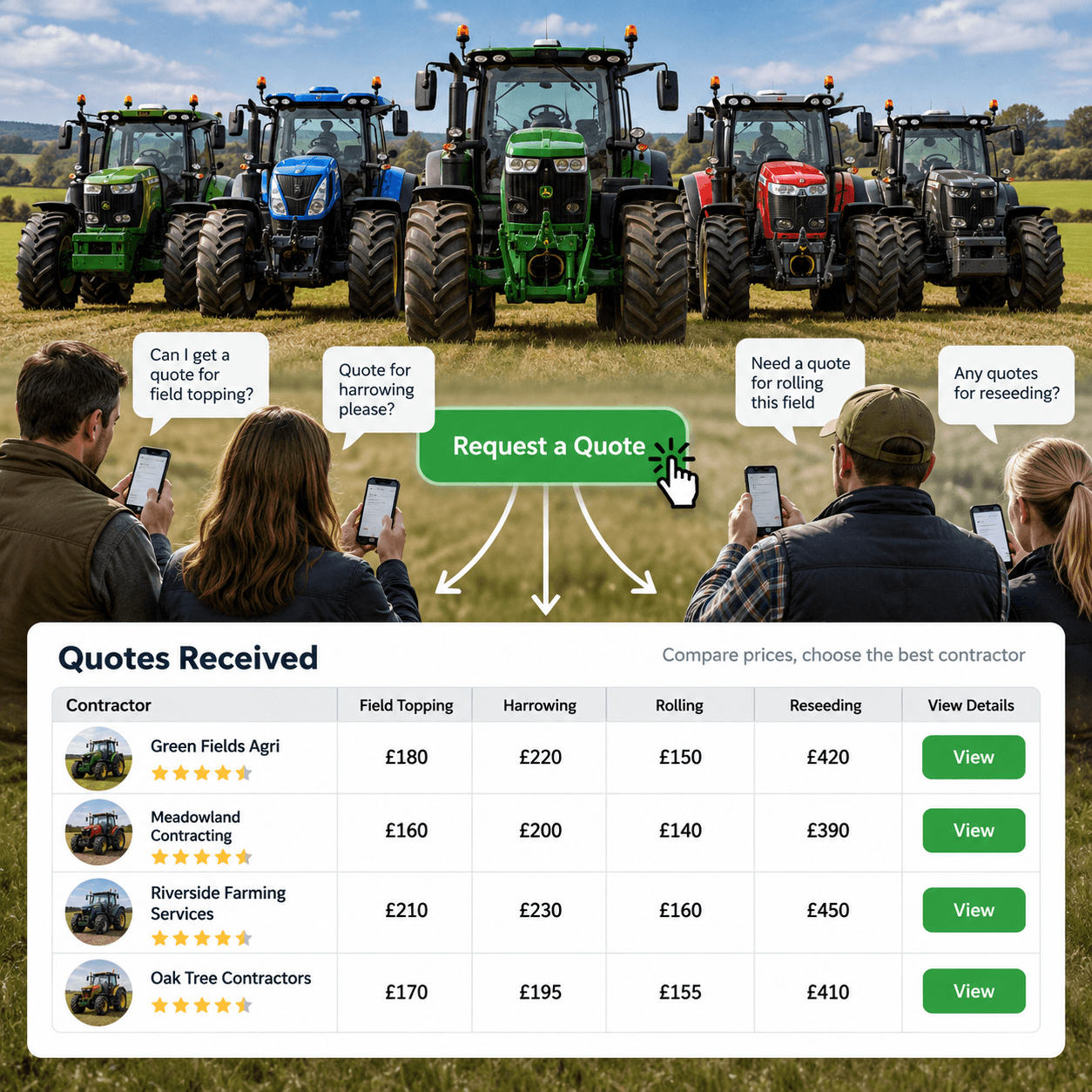
Prices usually start arriving within 24 hours. You get an email as they come in, and they all land on one page for your job.
Compare more than the number
The cheapest price is not always the best one, so the job page shows more than the figure. For each price you can see:
- The full price you would pay. This is the figure you are actually charged. Our fee is already in it, and each price says whether VAT is included.
- Their rating from previous customers. A contractor with fewer than three ratings is marked as new, so a short record doesn't count against them.
- How far away they are. A contractor ten miles off is easier to get back if something needs finishing.
- Their note to you. Contractors often say what kit they would bring, when they could come, or what they have assumed about the ground. This is often where the real difference between two prices shows up.
- How it is priced. Most prices are a fixed figure for the job. Some work, like tractor hire, can be priced by the hour or by the acre instead. In that case you see the rate.
- How long the price stands. Each price has a date it is valid until.
You can sort the list by lowest price, by highest rating, or by our recommended order, which weighs the two together.
Ask before you choose
If something in a price is unclear, message the contractor from your job page before you decide. Ask when they could start, what height they cut to, or whether they will take the cuttings away. The conversation happens on the job page, so you don't need to hand out your phone number just to ask a question.
Some contractors will say they want to see the site before they commit to a figure. That is normal for overgrown ground or awkward access. You can still book them, subject to a visit. If their price changes after they have seen the site, you can accept the new figure or decline it.
Say no to the ones that don't suit
If a price isn't right for you, press "Not for me" and pick a reason, such as too expensive or too far away. The contractor is told, in a word, so they know where they stood. They can send you a revised price if they want to.
If nothing suits at all, you can withdraw the job. Everyone who priced it is told, and that is the end of it.
Book the one you want
When you accept a price, you pay a 15% deposit by card to book the job. That is the only money taken up front.
The contractor gets in touch to agree a date. When the work is finished, they mark the job as done and you get an email. You then have three working days to confirm you are happy or tell us about a problem. The balance is only taken once you confirm, or once those three days pass without you raising anything. The contractor isn't paid before then either.
Why booking through the site matters
Comparing prices is the obvious benefit, but it is not the only one.
- We check every contractor before they see a job. We confirm who they are and that they run a working contracting business, and we talk to them before any job reaches them.
- Every job is covered by our insurance. We carry £5 million of public liability cover on every job done through the service. If something goes wrong, you deal with us, not with the contractor's insurer.
- You pay us, not the contractor. If the work isn't right, you raise it with us and we sort it out with the contractor. If it is incomplete or not done to a reasonable standard, we arrange for it to be put right within seven days at no cost to you.
A quick checklist
- Describe the job once, with photos if you can.
- Wait a few hours for prices to come in.
- Look at the rating, the distance and the note, not just the total.
- Message anyone whose price you don't fully understand.
- Pass on the ones that don't suit, so they can rethink if they want to.
- Book with a 15% deposit, and pay the rest once you are happy with the work.
When you have a job in mind, describe it here and see what comes back.