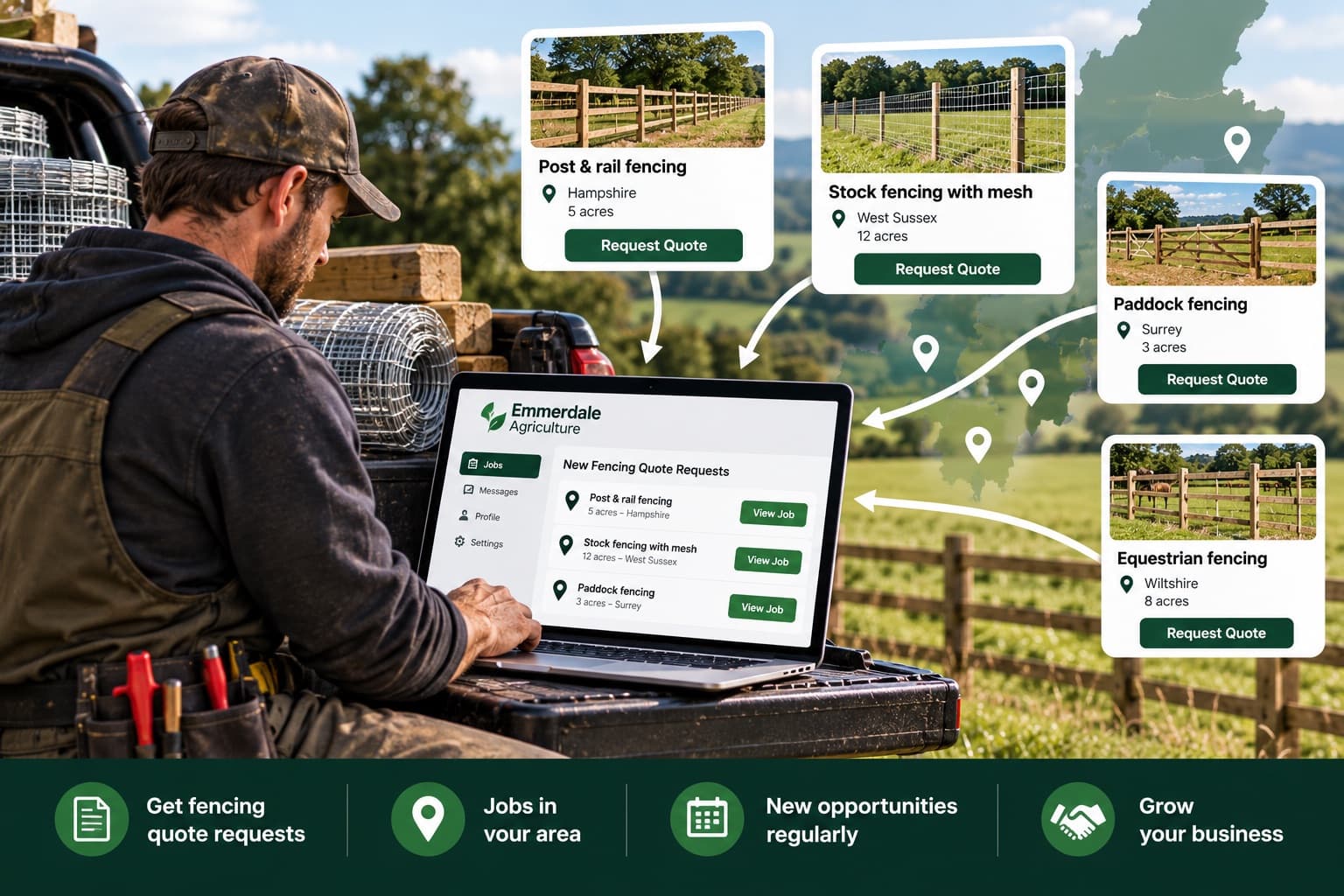
Most fencing work is won the slow way. A customer rings, you drive out to measure up, you send a price, and half the time you never hear back. Meanwhile the jobs that would suit you best, such as a run of post and rail ten minutes from your yard, go to whoever the customer's neighbour happened to recommend.
Emmerdale Agriculture brings fencing jobs to you. Customers describe the fence they need, and we send it to the contractors who cover that area. You price the jobs that suit you and pass on the rest. Joining is free.
What fencing jobs come through
Fencing jobs come from horse owners, smallholders and householders with land. They include:
- Post and rail round a paddock or along a field boundary
- Closeboard (featheredge), built on site or as panels, along a garden boundary
- Lap panels and trellis round a garden
- Picket fencing at the front of a property
- Gates, from pedestrian gates to driveway and 12ft field gates
- Replacing an old fence, including taking down and clearing what is there
Customers can also describe other work in their own words, such as stock fencing or repairs after a storm. If it is fencing, it reaches you.
Enough detail to price without a site visit
A fencing job is only worth pricing if you know what you're pricing. When customers post a fencing job, we ask them the questions you would ask on the phone:
- What type of fencing, with pictures so they pick the right one
- How tall, from 3ft to 6ft
- How many metres
- Wooden or concrete posts
- Whether they want a capping rail on boarded fences
- Any gates, and what size
- Whether the line is on a slope
- Whether the line needs clearing first
- Whether there is an old fence to remove
Many customers add photos too. With that in front of you, you can usually work out a price from your rate per metre without getting in the van.
If a job needs a look before you can commit, that's fine. You can price it subject to a site visit and confirm or change the figure once you've seen it. The customer can accept the new price or decline it.
How it works
- Sign up and pick your area. Tell us your base, the counties you cover and the work you do. We check who you are and that you run a working business, and we speak to you before any job reaches you.
- Jobs arrive by email. When a customer in your area posts a fencing job, you get it in your inbox with the details and photos.
- Price it or pass. One tap either way. There's no cost to quote and no obligation to. Passing costs you nothing and doesn't count against you.
- The customer chooses. Each contractor prices on their own, and nobody can see anyone else's figure. The customer compares the prices along with each contractor's rating and note, and books one.
- Do the work and get paid. The customer pays a deposit to book, and you get their details to arrange a date. When the fence is up, mark the job complete and send us your invoice.
You keep the price you quote
There's no joining fee, and nothing is taken off your invoice. Our margin is added on top of your price and paid by the customer, so the figure you quote is the figure you're paid.
You never invoice the customer and you never chase them for money. The customer pays a deposit before you start. The balance is due once they've confirmed the work is done, or automatically three working days after you mark it complete if they don't raise a problem. You're paid your full price once that balance has cleared and we have your invoice. If a customer doesn't pay, chasing them is our job, not yours.
Write a note with your price
Customers don't just look at the number. Every price has room for a note to the customer, and it is often what decides between two prices. Say what timber and posts you would use, whether the price includes removing the old fence and taking it away, roughly when you could start, and anything you've assumed about the ground.
Two prices that are £300 apart often turn out to be for two different fences. A clear note shows the customer why yours is worth it.
Fill the diary around your regular work
You don't need us to fill your whole week. For most contractors the value is in the gaps, such as a short job near a site you're already working on, or something to fill a quiet fortnight.
Fencing customers can come back, too. A horse owner who has a paddock fenced this year may want another one next year, or a gate, or the hedge cut. Do a good job and a single introduction can turn into a regular customer.
Optional premium membership
Joining and pricing jobs is free. If you want more, premium membership costs £20 a month or £199 a year. It gets you first refusal on jobs in your area before they open to everyone else, and a smaller margin is added to your prices, so the customer sees a more competitive figure for the same price to you.
You can join free and decide about premium later.
Fencers wanted across the UK
We added fencing to the network after a contractor asked for it, and we want more fencers on it in every county. You might be a dedicated fencing firm, or a land contractor who does fencing alongside topping, hedge cutting or groundwork. Either way, we'd like to hear from you.
Sign up here. Pick the counties you cover and tick fencing along with anything else you do. You can see the kind of fencing jobs customers post on our fencing contractors page.
Quick answers
What does it cost to join? Nothing. There's no joining fee and no commission taken off your invoice. Premium membership is optional.
Do I have to price every job? No. Price the ones that suit your diary and your area, and pass on the rest.
Do I set my own prices? Yes. We never price on your behalf and we never change the figure you give us.
Can I see what other contractors have quoted? No. Every price is sealed, so you're pricing the job, not trying to undercut someone else.
How do I get paid? You send us one invoice for the job, and we pay your full price once the customer's balance has cleared.
Will I get jobs other than fencing? Yes. You get the jobs posted in the counties you cover, and they include hedge cutting, clearance and general tractor work as well as fencing. Price the ones you can do and pass on the rest.