
If you run a small contracting business and you have ever put money into Facebook or Google adverts, you will know the feeling. The budget goes out, the phone rings a bit, and half the calls are from the wrong side of the county. You spend an evening replying to messages, drive out to look at two jobs that are further than you wanted to go, and win one. Then you do it all again next month.
This note is about why paid advertising is such poor value for a contractor who covers a small area, and what we do differently.
The advert does not know where your patch ends
Say you work within 25 miles of the yard. You build an advert, draw a 25-mile circle on the map, and set it running. The trouble is that the circle is a suggestion, not a rule.
Facebook shows the advert to people who live in the area, people who have recently been in the area, and people who were in the area when they last opened the app. Someone who drove through on the way to the coast counts. So does a horse owner from three counties away who stayed with family for the weekend. Google guesses where a searcher is from their phone or their broadband connection, and on a rural connection that guess is often the nearest town, not the field.
Every one of those clicks costs you the same as a good one. The person who clicks from 60 miles away, reads your page, and messages to ask if you cover their village has cost you money twice: once for the click, and once for the ten minutes you spend telling them no.
Put rough numbers on it
Take a modest budget of £10 a day, which is £300 a month. At around £1 a click, that buys roughly 300 visits to your page.
If a third of those come from outside the area you will travel to, £100 of the month has gone on people you would have to turn down. Of the 200 that are left, most are looking rather than buying. Perhaps one in twenty gets in touch. That is ten enquiries, and if you price them all and win three, each job has cost you about £100 in advertising before the tractor has left the yard.
That is a good month. In February nobody is searching for topping, and the advert either keeps spending on nothing or you switch it off and start from scratch in April.
Why a small area makes it worse, not better
A contractor covering three counties with four tractors has exactly the same wasted clicks. The difference is what they are spread over.
- The fixed costs do not shrink with your patch. The website, the hours learning the advert manager, the monthly fee for the trade directory that bills you whether or not the phone rings. A bigger firm spreads those over fifty jobs a month. You spread them over five.
- Small budgets never settle down. The advertising platforms work out who to show your advert to by watching who responds. Below a certain spend they never see enough responses to learn anything, so you pay the beginner's rate forever.
- You cannot narrow the audience much further. The tighter you draw the circle, the fewer people are in it, and the platform fills the gap by widening who it counts as "in the area".
The smaller and more local your business, the more of each pound goes on people who were never going to be your customer.
Where we come in
We run the advertising for the whole country, and we pay for it.
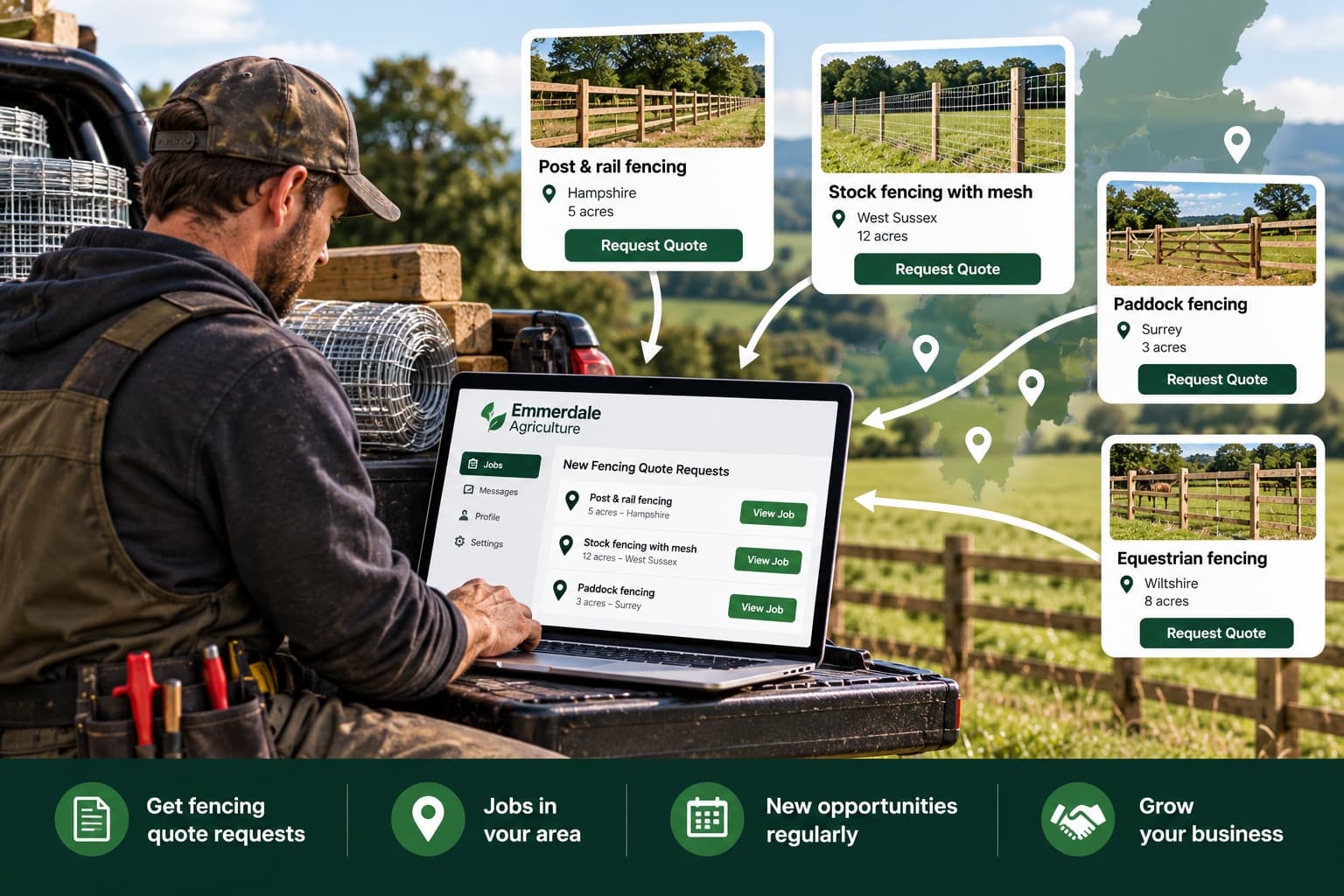
Emmerdale Agriculture advertises for land work across every county in England, Scotland, Wales and Northern Ireland: paid adverts on Facebook and Instagram, and pages built for every county that come up when someone searches for a paddock contractor, a hedge cutter or a bale of hay near them. When a customer finds us, they describe the job in their own words and give us the postcode.
That postcode is the point. The job goes only to contractors who have told us they cover that county and who are within reach of it, which is 40 miles unless you have told us otherwise. A job in Shropshire never reaches a contractor in Kent. Nearly 500 vetted contractors are on the network, and none of them pays for a click that belongs to somebody else's patch.
This turns the arithmetic on its head:
- A click from outside your area costs you nothing. It was never your click. If it turns into a job, it goes to the contractors who cover that ground.
- A click inside your area costs you nothing either. Seeing the job is free. Pricing it is free. Passing on it is free and does not count against you.
- There is no monthly fee and nothing is taken off your invoice. Our margin is added on top of your price and paid by the customer, so the figure you quote is the figure you are paid.
The waste that kills a one-man advertising budget does not disappear. We still pay for the browsers and the people who change their minds. But spread across hundreds of contractors and 99 counties, almost every click lands in somebody's patch, and the cost sits with us rather than with you.
What you still have to do
The network brings the job to you. Winning it is still down to you.
- Price promptly. A job goes to the contractors in range and the customer chooses between them. The first clear price with a sensible note is often the one that gets booked.
- Tell us where you will actually go. Pick the counties you cover when you sign up, and tell us how far you will travel when we speak. Jobs outside that range will not reach you, which is exactly how it should be.
- Say who you are. Every price has room for a note to the customer. The kit you will bring, when you could do it, and anything you noticed in their description. That note does the job your advert used to do, and it costs nothing.
Keep your own adverts if they work for you
We are not asking anyone to stop advertising. Plenty of contractors on the network keep a Facebook page and a good name locally, and they should. The network is the part of your marketing that does not cost anything until it pays.
If you cover a small area and you are tired of paying for clicks from the wrong side of it, join the network. It is free, you pick your counties, and the next job posted in them will land in your inbox.